


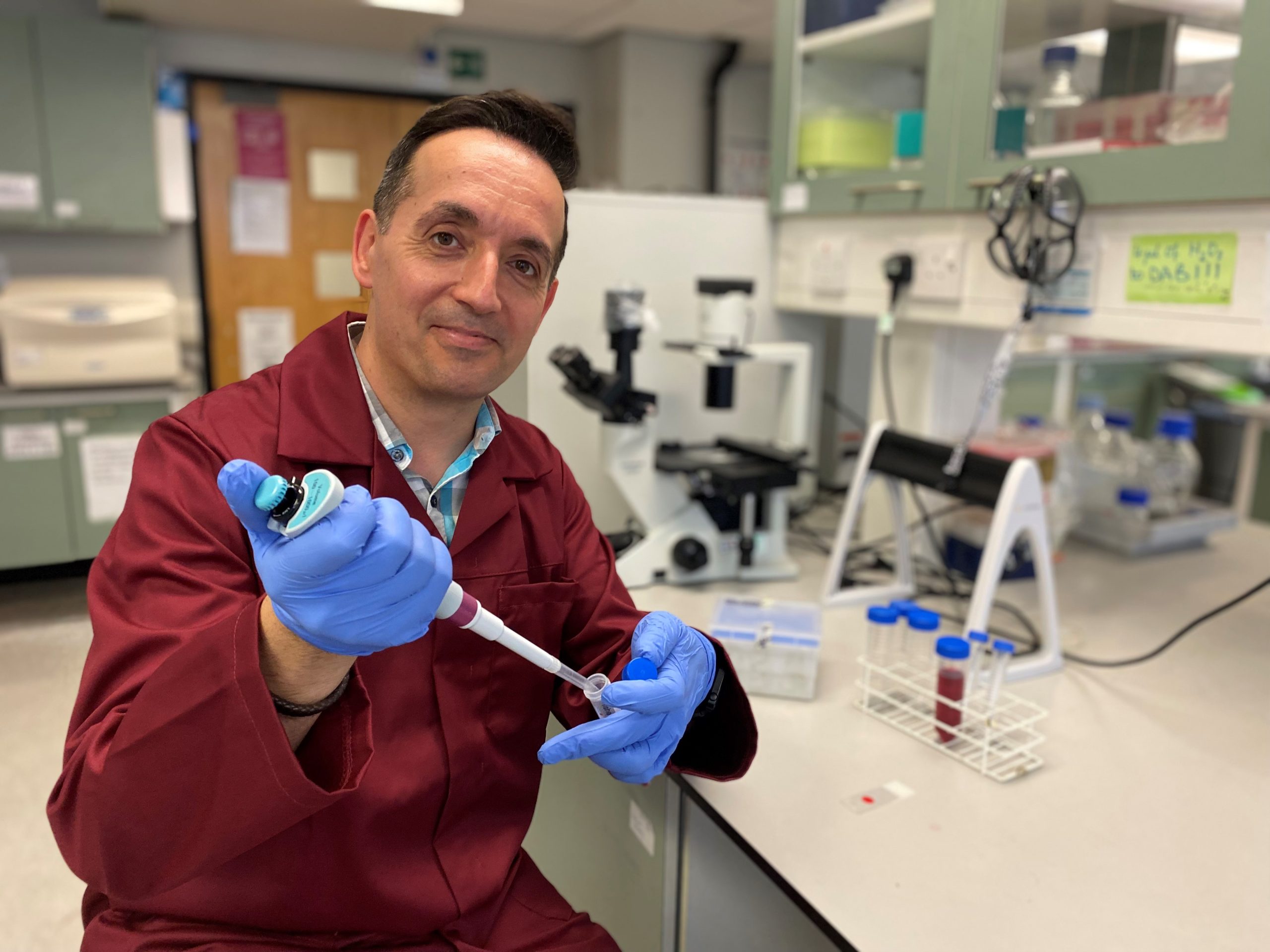
Losing hair during chemotherapy can be one of the most distressing side effects for patients but new research, in partnership with Paxman and led by Dr. Nik Georgopoulos at Sheffield Hallam University, could change that.
Dr. Nik Georgopoulos and his team were recently featured in news across the UK for their research on the oxidising effects of chemotherapy on hair follicles and the development of a topical agent to improve scalp cooling efficacy.
The research discovered that optimal cooling conditions of 18° C can prevent the generation of reactive oxidant species (ROS) during chemotherapy. These are unstable molecules that cause oxidative stress and damage key cells within the follicle which can lead to cell death.
However, reducing the scalp temperature sufficiently so that cooling alone will prevent cell death is not always feasible in clinical settings. Factors such as scalp thickness, blood flow, or issues preventing sufficient cooling such as poor cap fit, can all cause variability in individual scalp skin temperatures. This variability can lead to ROS generation and is believed to be a major reason why scalp cooling sometimes fails to prevent hair loss.
With this new knowledge, the team at Sheffield Hallam University’s Biomolecular Sciences Research Centre developed and tested a topical agent using a panel of antioxidants to counter the production of ROS. This topical formulation could be used to compensate for inadequate protection from cooling alone where conditions may not allow for it.
This is a huge milestone for scalp cooling efficacy and once widely available, could improve patient outcomes for every patient.
News outlets such as Sky News, The Independent, The Times, and The Conversation reported on this breakthrough earlier in July, with Nik appearing on BBC Radio Scotland for a live interview.
Paxman had the privilege of sitting with Dr. Georgopoulos in June to interview him about the work he and his team had been working on with Sheffield Hallam University (and formerly the University of Huddersfield).
Can you explain how the topical agent/antioxidants work?
“The combination of antioxidant and the topical product aims to deliver these special antioxidant molecules to the skin.
The aim of the topical product is to use nanoparticles that can specifically penetrate the skin and deliver these antioxidant compounds into the base of the hair follicles.
The aim of the antioxidant is to suppress the production of what are known as reactive oxygen species.
These are highly reactive oxygen molecules that are generated by chemotherapy drugs.
They cause the damage inside the cells, and they cause the death that then causes the destruction of the hair follicles.
By using this topical product, we'll be able to deliver these antioxidants to the hair follicles, which are powerful and can potentiate the ability of cooling to suppress or fully prevent the destruction of hair molecules and hair loss altogether.”
Is the topical agent intended to assist where the scalp would otherwise be unable to reach the optimum temperature of 18 degrees Celsius?
“The use of the topical product is indeed mainly aimed at making up for the inability of suboptimal cooling to protect.
Achieving the optimal temperature of 18°C is fundamental, and indeed we want to use the antioxidant to compensate for a scenario where the patient's head will not cool adequately enough to reach that temperature.
Another possibility, of course, is that even though the scalp cools adequately, the patient might be receiving a highly toxic chemotherapy drug.
By combining cooling with antioxidant, we can provide even stronger protection of what is quite a highly toxic chemotherapy regimen.”
How would this change the scalp cooling landscape and patient outcomes?
“The use of the topical product together with scalp cooling for us is the dream scenario of having the ability to say to the patients for the first time that your chance of keeping your hair is not 50 or 55%.
Imagine the dream scenario when you say to somebody, if you have scalp cooling combined with this topical product, you're pretty much guaranteed to keep your hair, which would be amazing.”
We often hear a lot of myths about scalp cooling either from patients or healthcare professionals. What is the biggest myth you’d like to bust about scalp cooling?
“I think the biggest myth that must be busted when it comes to scalp cooling is that it doesn't work. It does.”
Is there anything else people need to be aware of when it comes to scalp cooling?
“One important consideration when it comes to scalp cooling is that although our main focus is the prevention of hair loss, it is important to note that cooling is also very, very good at helping with hair recovery.
Our studies demonstrate that even if there is some significant hair loss, the recovery of the hair is accelerated by cooling.
And that's really, really important because following chemotherapy, hair does not always grow to the same extent, or it doesn't have the same texture or colour.
By cooling, even if the hair loss is substantial, the recovery is pretty much guaranteed to be much, much better.”
Dr. Georgopoulos’s paper, also co-authored by Khalidah Ibraheem, Adrian Smith and Andrew Collett, was published in the Frontiers in Pharmacology Journal as open access and is available to read now.


